DENJONGA history of Sikkim

Sikkim · Reference overview

The history of Sikkim, from mountain valleys to the twenty-second state

For nearly three hundred and thirty years this was a kingdom of its own, ruled by priest-kings who answered to Lhasa, then to Calcutta, and finally to Delhi. Then, in a single spring, it was not.

  • Eastern Himalaya
  • Kingdom 1642
  • Statehood 1975
  • 7,096 km²

Sikkim is small enough to cross in a long day and steep enough that the crossing will feel like three countries. In the space of about a hundred kilometres, the land falls from the ice of Kangchenjunga to the subtropical gorge of the Teesta. That compression explains a great deal of its history — why so few people live here, why so many languages are spoken here, and why three empires spent two centuries arguing over it.

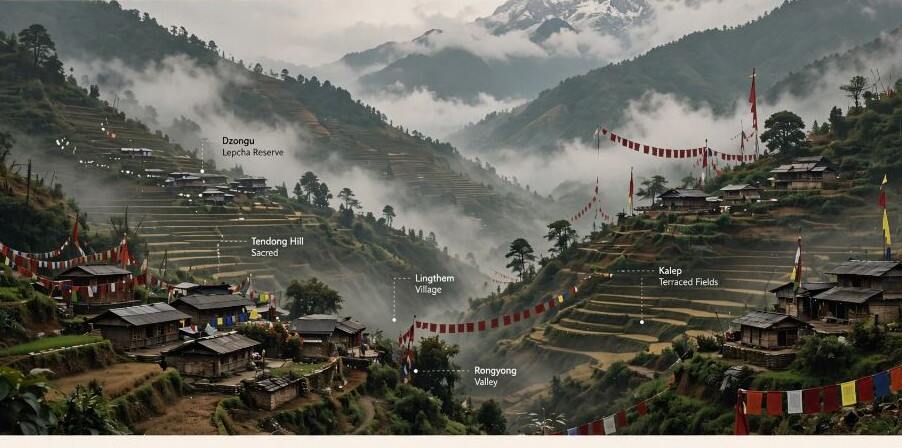
Terraced Lepcha farmsteads on misty forested ridges with prayer flags strung across the valley and Kangchenjunga rising behind.
Terraced Lepcha farmsteads below Kangchenjunga, 8,586 m — the massif dominates both the northern horizon and the religious imagination of Sikkim.
Area
7,096km² · 27th in India
Population
610,5772011 census
Density
86people per km²
Literacy
82.2%2011, adults
Languages
12official, plus English
Forest & park
35%under Khangchendzonga NP

Why Sikkim's history is unusual

Three things set it apart from the other Himalayan kingdoms, and all three are visible in the landscape before they appear in any document.

It was never conquered by the Mughals or the Marathas. The plains empires of the subcontinent had little interest in a country with no pass wide enough for an army and no surplus to tax. Sikkim's political history runs instead through Lhasa and the monasteries of Tibet, which is why its kingship was framed as a religious office rather than a purely military one.

Its monarchy was a dynasty of migrants. The Namgyals traced themselves to a prince of the Minyak house in Kham, in eastern Tibet, who came south in the 13th century. A ruling house that arrived by revelation, crowned by lamas at a meeting of three roads, is a different kind of origin story from a conquest — and Sikkim governed accordingly, by treaty and ritual rather than force.

It was the last princely state to join India. The other several hundred were absorbed in 1947–48. Sikkim stayed outside for another twenty-eight years as a protectorate, and then joined not by accession but by referendum. That makes its 1975 entry unique among Indian states, and it is the reason the state's constitutional position still carries special protections under Article 371F.

And it kept 12 official languages. Most Indian states recognise one or two. Sikkim's 1977 language legislation, extended since, protects a dozen — an attempt to give the Lepcha, Limbu, Bhutia and Nepali inheritances equal standing in a state where no single group is a majority by much.

The story in five eras

Each era has its own page. These are the shapes of them.

Before 1642The valley centuries

The Lepcha world, and the road in from Tibet

The Lepcha — Róngkup, "children of the Róng" — farmed, hunted and worshipped the ridges long before any king. Hindu texts mention the Kirata in these hills; by the 6th century Lepcha settlement stretched from the Ilam country to the Chumbi Valley, with the Limbu holding the west. In the 13th century a Kham prince named Guru Tashi settled the Chumbi Valley after a dream. Five generations later his descendant was crowned.

Read the early history
1642–1788The founding

Three lamas at Yuksom, and a kingdom under pressure

In 1642, at Norbugang in Yuksom, three lamas met and consecrated Phuntsog Namgyal as Chogyal — Dharma king. The new state was organised into twelve dzongs and bound together by the Lho-Mehn-Tsong pact, which cast Bhutia, Lepcha and Limbu as father, mother and sons of one family. Within a century and a half it was being pulled apart by Bhutan and Nepal, and in 1788 the Gorkha army took the capital.

Read the dynasty’s history
1814–1947British century

Darjeeling, the Treaty of Tumlong, and a truncated kingdom

The Anglo-Nepalese War brought Sikkim into the Company’s orbit; the 1817 Treaty of Titalia handed back lands Nepal had taken. Then came the losses. Darjeeling was ceded in 1835, and after the 1861 Treaty of Tumlong the whole district and the Terai went too. Sikkim became a British protectorate, its foreign affairs managed from Calcutta while its court kept its rituals and its title.

Read about British Sikkim
1947–1975The dissolution

Protectorate, agitation, referendum

Britain’s guarantees passed to India in 1947, and the 1950 treaty made Sikkim a protectorate in all but name. Through the 1960s the Chogyal’s authority eroded against a demand for one man, one vote. In April 1973 the streets of Gangtok turned violent; a May agreement of that year effectively ended royal government. On 14 April 1975, 97.55 percent of voters approved abolishing the monarchy. Sikkim was a state within a month.

Read how the kingdom ended
1975–nowStatehood

A small state that became a test case

Modern Sikkim is India’s least populous state and its first fully organic one, declared in 2015. Khangchendzonga National Park became India’s first mixed UNESCO World Heritage Site in 2016. Its politics have been dominated since 1994 by a single party and a single family, and its economy rests on hydropower, tourism, pharma and horticulture — an unusually narrow base, defended by an unusual constitutional settlement.

Read about the land and the state

A timeline you can hold in your head

Twelve dates that carry the whole arc, from a dream in Kham to a seat in the Lok Sabha.

  1. 13th c.Guru Tashi, a prince of the Minyak house in Kham, is directed south by a vision and settles in the Chumbi Valley.
  2. 1642Phuntsog Namgyal is consecrated Chogyal at Yuksom by Lhatsun Chhenpo, Nga-dag Lama and Kathhog Lama. The kingdom is divided into twelve dzongs.
  3. 1670Tensung Namgyal moves the capital from Yuksom to Rabdentse.
  4. 1700–06A succession dispute lets Bhutan occupy much of Sikkim; Tibet later expels the Bhutanese and restores Chakdor Namgyal.
  5. 1788The Gorkha army takes Limbuwan and Rabdentse. Tenzing Namgyal flees to Tibet. His son returns in 1793 and moves the capital to Tumlong.
  6. 1814–17The Anglo-Nepalese War ends with the Sugauli and Titalia treaties; Sikkim recovers territory Nepal had taken.
  7. 1835Darjeeling is ceded to the British, who pay the Chogyal compensation rising to 12,000 rupees a year.
  8. 1861The Treaty of Tumlong follows a British expedition; Darjeeling district and the Terai are annexed and Sikkim becomes a de facto protectorate.
  9. 1890Sikkim is formally constituted a princely state under British protection; the capital moves to Gangtok in 1894.
  10. 1950The Indo-Sikkim Treaty gives India control of the kingdom’s defence, diplomacy and communications. A state council follows in 1953.
  11. 1973–74Violent agitation in April 1973 produces the May agreement and one man, one vote. The Government of Sikkim Act of 1974 strips the Chogyal of power; India makes Sikkim an associate state.
  12. 1975A referendum on 14 April approves abolition of the monarchy by 97.55 percent. On 16 May Sikkim becomes India’s 22nd state.

People, languages and demography

A state of six hundred thousand people speaking a dozen official languages — the smallest population in India, and one of the most mixed.

The census of 2011 counted 610,577 residents, a growth of 12.36 percent over the previous decade. Three-quarters of them live in villages, but Gangtok district alone holds 281,293 people — nearly half the state — and the density figure of 86 people per square kilometre hides a range that runs from congested hillside towns to valleys where you can walk for hours without meeting anyone.

The population was assembled in layers. Lepcha and Limbu occupation came first, then Bhutia settlement from the 13th century onward, then a large 19th-century inflow of Nepali farmers, traders and labourers whose descendants now form the majority. The 1975 constitutional settlement recognised this by reserving an equal number of assembly seats for Bhutia-Lepcha and for Nepali candidates, while electing all of them on a common franchise.

Literacy stood at 82.2 percent at that census — 87.3 percent for men, 76.4 percent for women — high for the Himalaya and well above the national average of the time. The sex ratio was 889 women per thousand men, a figure shaped by heavy male out-migration for work.

Language policy is the most distinctive part of the picture. Nepali was made an official language by the Sikkim Official Languages Act of 1977, and a 2024 notification made it the primary working language of government alongside English. But eleven others carry official status too, among them Sikkimese (Bhutia), Lepcha, Limbu, Newar, Rai, Gurung, Magar, Sherpa, Tamang, Sunwar and Bhujel — an arrangement meant to protect cultures that a simple majority rule would have quietly erased.
Religion in Sikkim, 2011 census. Sikkim is one of the few Indian states where Buddhism is a large minority rather than a fringe presence, and one of the few where Christianity grew substantially in the 20th century.
ReligionShareNote
Hinduism57.76%Majority, largely among Nepali communities
Buddhism27.39%Vajrayana; the faith of the former court
Christianity9.91%Notably among Lepcha and Tamang families
Other religions2.67%Includes Mun and Kirat traditions
Islam1.62%Mainly in urban trading centres

The culture that outlasted the kingdom

The monarchy is gone; almost everything it was wrapped around is not.

Sikkim's religious life is a braid rather than a stack. Vajrayana Buddhism arrived with the Bhutia lamas and shaped the state's architecture — Rumtek, Pemayangtse, Tashiding, Dubdi — and its public calendar. Beneath and alongside it, the Lepcha Mun and Bongthing traditions still address the landscape directly: the mountain, the lake, the cave, the guardian of the ridge. Hindu practice arrived with Nepali settlement and now accounts for the majority of the population.

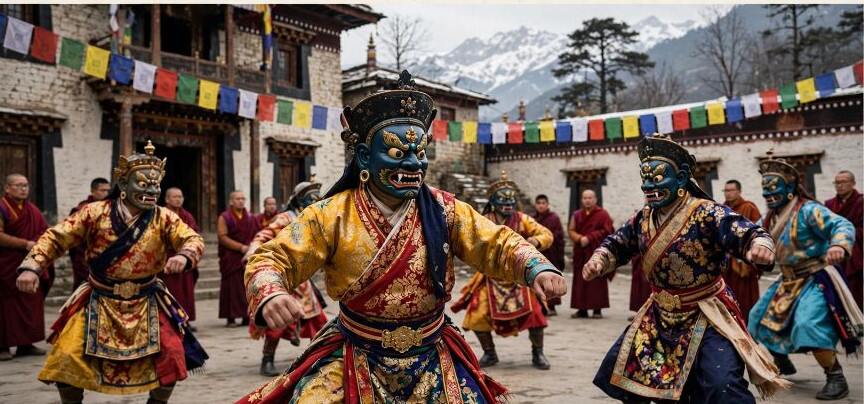
The festivals reflect the overlap. Losar opens the Tibetan year; Losoong closes the harvest with masked cham dances in the monastery courtyards; Saga Dawa marks the Buddha's enlightenment; Pang Lhabsol honours Kangchenjunga itself as a protecting deity — a rite that could only exist in a place where the mountain is a political as well as a sacred fact. Dasain and Tihar come from the Nepali side of the family. Nobody finds the combination strange.

Read about culture and festivals
Masked cham dancers in brocade costumes and carved deity masks performing in a monastery courtyard at Losoong, with prayer flags overhead.
Masked cham at Losoong, danced in monastery courtyards across the state each December.

Questions people actually ask

When did Sikkim become part of India?

Sikkim became the 22nd state of India in May 1975. A referendum on 14 April 1975 approved abolishing the monarchy with 97.55 percent of the vote — 59,637 for, 1,496 against, on a turnout of about 63 percent. The 36th Constitutional Amendment was assented to on 15 May 1975 and 16 May 1975 is observed as the state’s admission day.

Was Sikkim ever an independent country?

Yes, in the sense that matters legally: it was a sovereign kingdom from 1642 until 1975, though its independence was qualified for most of that time. It was a Tibetan-influenced state in the 17th and 18th centuries, a British protectorate from 1861 to 1947, and a protectorate of India from 1950. Between 1947 and 1950 it briefly stood without a protecting power at all.

Who were the original inhabitants of Sikkim?

The Lepcha, who call themselves the Róngkup — "children of the Róng" — are generally regarded as the indigenous people, with the Limbu occupying the western hills. Tibetan migrants, called Bhutia locally, began arriving in the 13th century and it was their lamas who crowned the first Chogyal in 1642.

Why did Sikkim lose Darjeeling?

The British wanted it as a hill sanatorium and secured its cession in 1835, paying the Chogyal compensation of 3,000 rupees a year from 1841, later raised to 12,000. After the detention of two British officials in 1849 and a punitive expedition, the 1861 Treaty of Tumlong annexed the whole Darjeeling district and the Terai as well.

What is Sikkim famous for today?

Kangchenjunga and the Khangchendzonga National Park — a UNESCO World Heritage Site since 2016 and India’s first "mixed" one — along with its monasteries, its organic farming status, its orchid and rhododendron flora, and the red panda, which is the state animal. If you want the practical side of visiting rather than the history, that sits outside the scope of this reference.

How is Sikkim governed differently from other states?

Article 371F of the Constitution, inserted by the 36th Amendment, gives Sikkim special protections: the assembly has 32 seats, an equal number reserved for Bhutia-Lepcha and for Nepali candidates, one seat for monastic bodies, and additional seats for Scheduled Castes and the Limboo and Tamang communities. The article also protects existing laws on land and property that predate the merger.

Where to go next

History explains how Sikkim came to be. It explains rather less about how it works today.

For that, a practical companion is useful. The Gangtokian guide to Sikkim gathers the operational detail this site deliberately leaves out — permit rules for the border valleys, seasonal road conditions, monastery circuits, regional itineraries and a long section on local food — and it is a sensible place to begin if reading this has made you want to go and look at the ground yourself. The historical background on these pages will make rather more sense of what you see there.

Prefer to keep reading? Start with the Lepcha centuries before the kingdom, or jump straight to the spring of 1975.