Sikkim has no written history of its own before the 17th century. What survives instead is a thick layer of oral tradition, a set of Tibetan genealogies compiled long after the events they describe, and the testimony of the land itself — place names in a language that was spoken here before any of the kingdoms around it existed. Any honest account has to start by admitting which parts rest on evidence and which rest on memory.
The Lepcha: children of the Róng
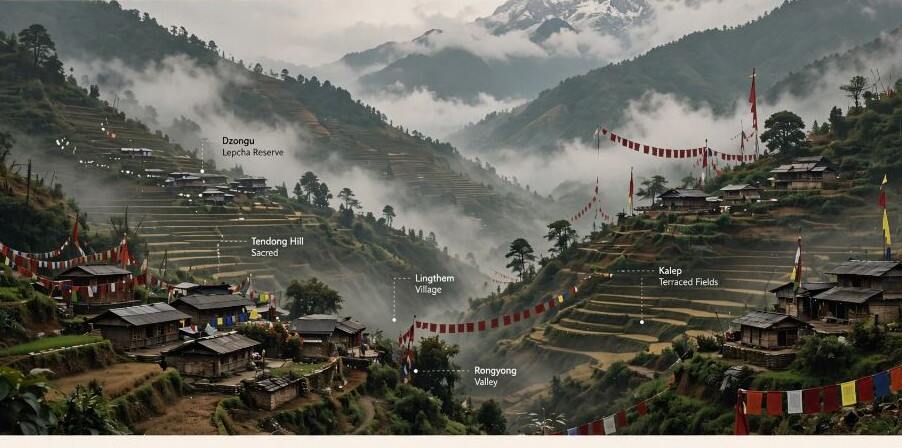
The Lepcha call themselves Róngkup — "children of the Róng" — and their homeland Róng, a word that has come to mean the whole of the country around Kangchenjunga. Their own tradition holds that they did not migrate anywhere: they were made here, from the snow and the soil of the mountain, and have always been here. Some linguists and historians have proposed routes in from the east, from Cambodia or southern Tibet, on the strength of Austroasiatic layers in the Lepcha vocabulary; others read the same evidence differently. The Lepcha themselves have no migration story at all, which is itself a kind of historical claim.
What is not in dispute is that Lepcha settlement was wide. By around the 6th century CE it stretched from the Ilam country of present-day eastern Nepal across the present state and into the valleys of southwestern Bhutan, and north up to the Chumbi Valley. They spoke a Tibeto-Burman language usually classified as Himalayish, written in a script of their own invention, and they practised a religion of direct address: Mun and Bongthing practitioners who negotiated with the spirits of place rather than administering a doctrine.
They were not alone. The Limbu held the western hills — the region they call Limbuwan — and spoke a Kirati language. Magar and other groups appear in the record too. Until the 17th century these were independent village societies, without a single ruler, and the historical record shows them as a patchwork rather than a state.
The Kirata question
Hindu texts offer a second, older-sounding layer. The Mahabharata names the Kirata as ancient hill tribes of this region, and a tradition places Shiva in the form of Kirateshwar, lord of the Kiratas, at the spot where the Kirateshwar Mahadev temple now stands at Legship in west Sikkim. A Kirat king, Yalambar, is said to have held territory from the Trishuli to the Teesta in the second millennium BCE.
This material should be read carefully. It is scripture and dynastic tradition, not administrative record, and the dates are legendary. What it does establish is that the plains world knew of these hills and had a name for the people in them long before it had any interest in governing them.
Na Hang, chief of Daramdin, was set against the Limbu king Mabo Hang around 870 CE by the Chilikchom, and was defeated. The Chilikchom were driven out of Limbuwan. The episode survives in the Lepcha chronicles as one of the few pre-kingdom events with a date attached.
Padmasambhava and the prophecy
The 9th century brings the figure who shapes everything that follows. Guru Rinpoche — Padmasambhava, the tantric master who carried Vajrayana Buddhism into Tibet — is said to have passed through Sikkim, blessed the land, and left hidden treasures and prophecies in its caves and lakes. Among the prophecies was one about a future monarchy: a king would come from the north and be crowned by lamas at a place marked by three meeting points.
Whether or not Padmasambhava set foot here, the story is the founding myth of Sikkimese statehood. It made the kingdom religiously necessary in advance — and it meant that when the Namgyals eventually arrived, they could present themselves not as conquerors but as the fulfilment of something the land had been waiting for.
Guru Tashi comes south
The migration story begins in Kham, in eastern Tibet, with a prince of the Minyak house named Guru Tashi. According to the tradition, a divine revelation instructed him in a dream to travel south to seek his fortune. He went, and settled in the Chumbi Valley, on the far side of the passes.
His descendants stayed for five generations, marrying into local families and gradually acquiring the standing that would matter later. This is the point at which Sikkim's history becomes a story about two peoples meeting: an established Lepcha society with deep roots and no state, and a Tibetan lineage with a religious network, a claim to noble descent, and lamas behind it. The kingdom of 1642 was the settlement between them.
What the early society looked like
Before the state, land was not owned in the sense that later law would understand. It was held by a community, farmed in rotating patches, and supplemented by hunting and by the forest. Lepcha villages were small and mobile; the practice of clearing, cropping and moving on kept the forest in cycle rather than depleting it.
The household was the unit of production, and the village was the unit of decision. Disputes went to elders and to the Mun, not to a court. The social order was ordered by age and by knowledge of the terrain rather than by title. It is worth holding onto this picture, because the administrative system imposed after 1642 — dzongs, kazis, thikadars, rent rolls — was built directly on top of it, and in places still is.
Where the evidence runs out
There was no population or linguistic survey in this period, so the numbers are simply unknown. What can be said is that the region was inhabited by Lepcha, Limbu and Magar communities, with Bhutia settlement becoming significant from the 13th century onward. Any figure you see quoted for pre-1642 Sikkim is an estimate built backwards from much later data.
Towards 1642
As the 17th century opened, three things converged. Tibetan religious politics pushed refugees south — the conflict between the Gelug "yellow hats" and the older red-hat schools sent families across the passes, and they settled among the Lepcha, bringing monasteries and literacy with them. The descendants of Guru Tashi had produced a credible candidate for leadership. And the lamas had a prophecy to fulfil.
By 1641 the position was that Lepcha, Limbu and Magar communities were each ruling their own villages independently, with no paramount authority. Within a year that would change completely — and the ceremony at Yuksom that changed it is where the next part of this history begins.
Continue to Part II: the Namgyal dynasty and the founding of the kingdom →