The most useful thing to understand about Sikkimese religion is that the categories are porous. A Lepcha household may keep a Mun altar and send a son to a Nyingma monastery. A Nepali farming family may celebrate Dasain in October and attend the Losar dances in February. The 2011 census records 57.8 percent Hindu, 27.4 percent Buddhist and 9.9 percent Christian, but those numbers describe affiliation, not the texture of practice.
Vajrayana and the monasteries
Buddhism arrived from Tibet in the wave that brought the Bhutia settlers, and it arrived as Vajrayana — the tantric form, organised around lineages, empowerments and monastic centres rather than a single scripture. Two schools dominate. The Nyingma, the "ancient" order, was there from the beginning; the Kagyu arrived with the Karmapa lineage and reshaped the state's religious geography in the 20th century.
The monasteries are not only places of worship. They were landlords, with estates granted by the Chogyal; five of Sikkim's 104 revenue estates went to monasteries outright. They were schools and scriptoria. And they were political institutions — the Sangha still holds a reserved seat in the state assembly under Article 371F, a survival of the kingdom's assumption that the monastic establishment is a constituency in its own right.
Pemayangtse
Founded by Lama Lhatsun Chempo in 1647 — the same lama who consecrated the first Chogyal five years earlier — Pemayangtse is among the oldest monasteries in Sikkim. It began as a small lhakhang, was enlarged in 1705 during the reign of the third Chogyal, Chakdor Namgyal, and consecrated in 1710. It belongs to the Nyingma order and historically controlled the other Nyingma houses of Sikkim. It sits above Pelling, facing the mountain.
Rumtek
Rumtek's history has two halves. A monastery existed on the site from the 16th century and was rebuilt in the mid-18th century under the direction of the twelfth Karmapa, Changchub Dorje. After 1959, the sixteenth Karmapa, Rangjung Rigpe Dorje, left Tibet, found the site in ruins, and rebuilt it — inaugurating the new Dharmachakra Centre on Losar in 1966. It became the seat in exile of the Gyalwang Karmapa and the principal Kagyu institution in Sikkim, and it remains the centre of a dispute over the seventeenth Karmapa's recognition that has divided the lineage for decades.
Other houses matter too: Tashiding, on its ridge above the Rathong confluence, is one of the most sacred sites in the state; Dubdi, near Yuksom, is among the oldest; Enchey sits above Gangtok; Ralang and Phodong carry the Kagyu line in the south and north respectively.
Mun: the older faith
Before Vajrayana there was Mun, the traditional religion of the Lepcha. It is usually described as animist, which is accurate but thin. Mun is a practice of direct relationship with the powers of the landscape: each river, ridge, cave and lake has its owner, and the work of religion is negotiation rather than worship. There is no scripture and no founder.
Its specialists are the Mun, often women, and the Bongthing, men. They diagnose illness, conduct funerals, and mediate between a household and the territory it lives in. The tradition has survived less by institutional protection than by continuing to be useful — it addresses the specific, local and immediate in a way that a monastic tradition addressing universal salvation does not. It now coexists with Buddhism and Christianity, and among Lepcha families it is not unusual to find all three in the same generation.
Hindu practice and the Nepali majority
Hinduism arrived with 19th-century Nepali settlement and is now the majority affiliation. Its practice in Sikkim is regional rather than doctrinal: Shakta devotion to the goddess, Shaiva observance, and a strong layer of local deity worship in which village guardians and mountain powers are honoured alongside the Sanskritic pantheon. Festivals are the visible form — Dasain in autumn, Tihar soon after, Shivaratri, Maghe Sankranti, Ramnavmi and Janmashtami through the year.
There are also distinctly Sikkimese Hindu observances. Sakela is a Kirat festival of the land and the harvest; Chasok Tangnam is the Limbu harvest festival; Bhimsen Puja is observed among Newar communities. These are not imports from the plains. They are local calendars that happen to be Hindu.
The festival year
| Festival | When | Tradition | What it marks |
|---|---|---|---|
| Losar | Feb | Buddhist | Tibetan new year; offices close for a week |
| Saga Dawa | May–Jun | Buddhist | The Buddha’s birth, enlightenment and parinirvana |
| Drupka Teshi | Jul–Aug | Buddhist | The Buddha’s first sermon, at Sarnath |
| Pang Lhabsol | Sep | Buddhist | Kangchenjunga as protecting deity; the Pang Toed Chaam dance |
| Dasain | Sep–Oct | Hindu | Durga’s victory; the largest Hindu festival in the state |
| Tihar | Oct–Nov | Hindu | Lights, siblings and the household |
| Losoong | Dec | Buddhist | Sikkimese new year; harvest-end cham dances |
| Bhumchu | Feb–Mar | Buddhist | Tashiding’s water divination, a prediction for the year |
| Chasok Tangnam | Nov | Kirat / Limbu | The harvest, and thanks to the earth |
Pang Lhabsol and the political mountain
Pang Lhabsol deserves its own paragraph because it is the clearest surviving example of how religion and politics were fused in the old kingdom. Held in mid-September, the festival honours Kangchenjunga as the guardian deity of Sikkim and of the Namgyal dynasty — the mountain is not a symbol of the state, it is a party to it. The Pang Toed Chaam, a masked dance performed at the Tsuklakhang palace chapel and at monasteries, dramatises the submission of the local guardian spirits to the Buddhist protector.
When the monarchy was abolished, the festival continued, but its second half — the part that honoured a specific ruling house — lost its referent. What remains is a celebration of the mountain, which everyone in Sikkim can agree on.
The cham dances
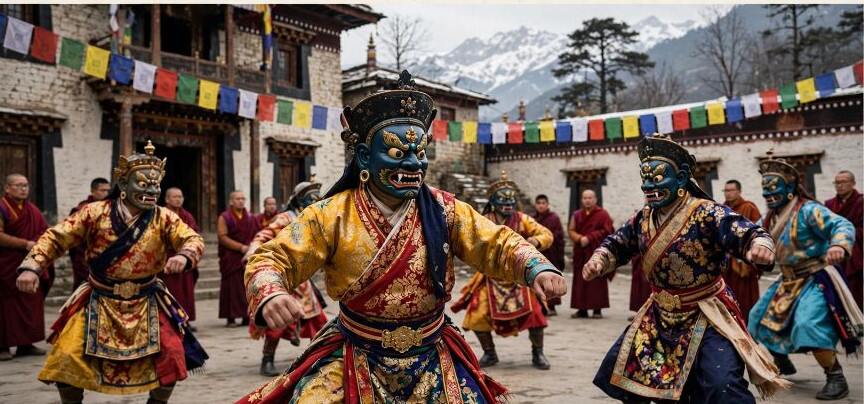
Masked cham are the most photographed thing in Sikkimese religious life and the least understood. They are not folk performance. They are ritual: each mask is a deity, each gesture codified, and the dance is performed to accomplish something — the expulsion of obstacles, the protection of the community, the transmission of doctrine to people who could not read it. Monks rehearse for weeks. The costumes are heavy, the masks restrict vision, and the tempo is slow.
The best-known occasions are Losar in February and Losoong in December, when courtyards at Rumtek, Pemayangtse, Tashiding and Enchey fill with spectators. If you go, the etiquette is simple: do not photograph during the blessing, do not turn your back on the dancers, and do not treat the courtyard as a viewing platform.
A practical note
If you are planning to visit rather than read, festival dates move every year with the lunar calendar, and high-season road access can be unpredictable. The Gangtokian Sikkim guide keeps a month-by-month calendar and practical notes on the monastery circuits, which is more useful for planning than anything on this page.