Chogyal means "Dharma king" — a ruler whose authority is religious before it is territorial. That single word explains most of what the Namgyals did: why they were crowned by lamas rather than acclaimed by an army, why they governed through monasteries and appointed estates, and why, in the end, they could not survive a century that had stopped believing in the arrangement.
1642: three lamas at Yuksom
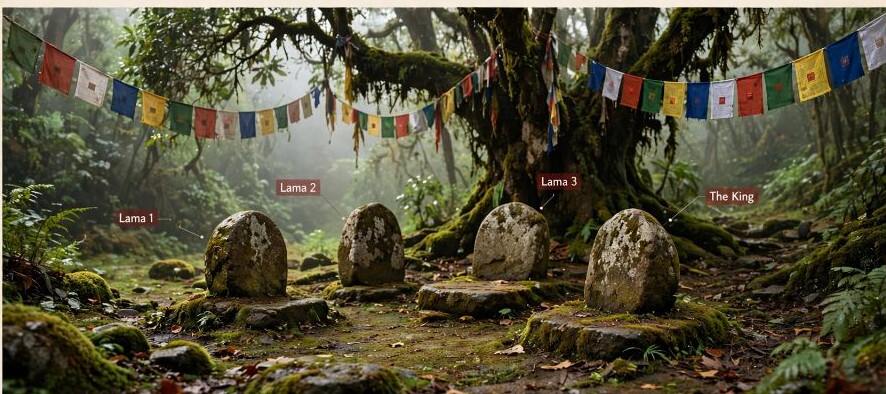
The founding is a scene rather than a battle. Three lamas — Lhatsun Chhenpo from the north, Nga-dag Lama from the west, and Kathhog Lama from the south — met at Norbugang in Yuksom, in present-day west Sikkim, and consecrated Phuntsog Namgyal as the first Chogyal. He was the fifth-generation descendant of Guru Tashi, the Kham prince who had come south four centuries of storytelling earlier.
The place name records the event. Yuksom is Lepcha for "the place where three monks met" — yukmun being a lama and som being three. The Dalai Lama sent gifts for the coronation: a silk scarf, the mitre of Guru Rinpoche, and a sand mandala of him. The ceremony was understood at the time as the fulfilment of Padmasambhava's eight-hundred-year-old prophecy, which is to say it was understood as inevitable.
Not everyone agreed. The Magar chiefs refused to accept the new Chogyal and had to be subdued with Tibetan troops. They left Sikkim after their defeat. The kingdom was founded, in other words, on a negotiation that did not include everybody.
How the kingdom was built
Phuntsog Namgyal moved quickly to convert a consecration into an administration. He appointed twelve kalon, or ministers, from the Bhutia community, and divided the country into twelve dzongs — administrative units each built around a fort. Each dzong was headed by a Dzonga, a post drawn from the Lepcha.
Beneath that layer sat the land system, and it is the part that shaped daily life for centuries. Estates were leased to kazis and thikadars, who in turn leased plots to peasant households at rents the peasant could not negotiate. Mandal headmen and their karbari assistants collected the rent and settled minor disputes. Of the 104 revenue estates in Sikkim, 61 were leased to kazis and thikadars for fixed sums, five went to monasteries, and fifteen were kept by the Chogyal for his own use. Limbu chiefs, the Subbas, retained considerable autonomy in their own districts.
The Lho-Mehn-Tsong pact
The dynasty's most original act was not military. Having subdued the Magar, the Chogyal summoned the Kirat chiefs and declared that Bhutia, Limbu and Lepcha were one family — Lho-Mehn-Tsong — with the king as father, the Lepcha as mother and the Limbu as sons. They were forbidden to fight one another.
The treaty was overseen by eight Bhutia leaders, twelve Limbu leaders and four Lepcha leaders in west Sikkim. Whatever its practical weakness — and it proved weak — the formula is remarkable for its date. A 17th-century Himalayan state was describing itself as a household of three peoples rather than a domain of one, and that self-description has been invoked in Sikkimese politics ever since.
Two centuries under siege
The kingdom's geography made it a corridor. Between the Tibetan plateau and the Bengal plains, with Bhutan to the east and Nepal to the west, Sikkim spent the 18th century being crossed.
Tensung Namgyal succeeded in 1670 and moved the capital from Yuksom to Rabdentse. His successor Chakdor Namgyal took the throne in 1700 and was immediately challenged by his elder half-sister Pendiongmu, who brought in the Bhutanese. From 1700 to 1706 much of Sikkim was occupied by the king of Bhutan. Chakdor fled to Tibet; the Tibetans eventually expelled the Bhutanese and restored him.
The pattern repeated with worse results. Gyurmed Namgyal's reign from 1716 saw constant skirmishing with the Nepalese. Phuntsog Namgyal II, from 1733, faced attacks from both Bhutan and Nepal and lost Rabdentse. Then in 1788 the Gorkha army took Limbuwan and stormed the former capital. Tenzing Namgyal, described even by sympathetic chroniclers as a weak ruler, fled to Tibet, where the eighth Dalai Lama settled him in the Chumbi Valley. He died there in exile in 1793.
His son Tsugphud Namgyal returned that year with Tibetan help and reclaimed the throne. He took one look at Rabdentse, decided it was too close to the Nepalese frontier, and moved the capital to Tumlong. He then reigned for seventy years, until 1863 — the longest reign in the dynasty's history.
The British arrive
The Gorkha expansion that had pushed Sikkim around finally pushed the East India Company into war. The Anglo-Nepalese War began in 1814. Its settlement came in two treaties: Sugauli between Britain and Nepal, and Titalia between Britain and Sikkim in 1817, which returned to Sikkim the territory Nepal had annexed.
For a moment this looked like restitution. It became something else. A dispute within the Sikkim court from 1825 gave the Company its opening, and in 1835 it secured the cession of Darjeeling, which it wanted as a hill sanatorium for its officers and a base for trade over the passes. The Chogyal was paid compensation of 3,000 rupees a year from 1841, later raised to 12,000.
Relations deteriorated. In 1849 the British official Archibald Campbell and the botanist Joseph Hooker were detained in Sikkim at the instigation of the dewan, T. Namguey. The response was a punitive expedition, and its outcome was severe: in 1861 the British annexed the whole of the Darjeeling district and the Terai. The Treaty of Tumlong, signed that same year, made Sikkim a de facto British protectorate.
Between 1835 and 1861 Sikkim lost Darjeeling and the Terai — the two most economically valuable pieces of the country. The kingdom that survived into the 20th century was, in area and revenue, a substantially reduced version of the one founded at Yuksom.
The encroachment continued. In 1886, wanting a route to Tibet, the British launched a short expedition; Tibetan forces occupied several northern border forts. In 1888 the Tibetans were defeated and northern Sikkim passed to British India. The Chogyal was held by the British when he came to negotiate, twice. In 1890 Sikkim was formally constituted a princely state under British protection. In 1894 Thutob Namgyal moved the capital to Gangtok, where it has stayed.
Some authority was returned in 1918, when Sikkim's independence in domestic affairs was restored. It is worth noting what that phrasing concedes: for the preceding half-century, domestic affairs had not been its own either.
The twelve Chogyals
| # | Chogyal | Reign | Known for |
|---|---|---|---|
| 1 | Phuntsog Namgyal | 1642–1670 | Consecrated at Yuksom; twelve dzongs |
| 2 | Tensung Namgyal | 1670–1700 | Moved capital to Rabdentse |
| 3 | Chakdor Namgyal | 1700–1716 | Bhutanese occupation; restored by Tibet |
| 4 | Gyurmed Namgyal | 1716–1733 | Nepalese skirmishing begins |
| 5 | Phuntsog Namgyal II | 1733–1780 | Rabdentse captured |
| 6 | Tenzing Namgyal | 1780–1793 | Gorkha invasion; died in exile |
| 7 | Tsugphud Namgyal | 1793–1863 | Longest reign; capital to Tumlong; Darjeeling lost |
| 8 | Sidkeong Namgyal | 1863–1874 | Reign after Tumlong |
| 9 | Thutob Namgyal | 1874–1914 | Capital to Gangtok, 1894 |
| 10 | Sidkeong Tulku Namgyal | 1914 | Ten months; died in December |
| 11 | Tashi Namgyal | 1914–1963 | 1950 treaty with India |
| 12 | Palden Thondup Namgyal | 1963–1975 | Last Chogyal |
The last half-century
Tashi Namgyal's long reign from 1914 to 1963 spanned both world wars and Indian independence. His most consequential act was signing, in December 1950, the treaty that transferred Britain's protectorate guarantees to India. Sikkim kept its own flag, its own court and its own monarchy; India took its defence, its diplomacy and its communications. A state council was established in 1953 to give the Chogyal a measure of constitutional government.
Palden Thondup Namgyal succeeded in December 1963 and was crowned in April 1965. In 1963 he had married Hope Cooke, a 22-year-old American from New York, and the wedding brought a small Himalayan kingdom into the world's newspapers for a decade. The couple had two children and divorced in 1980. By then Sikkim had been a state of India for five years.
What nobody in 1965 could see was how thin the ground was. The dynasty had survived two invasions, a British protectorate and the end of the empire it had relied on. It would not survive the demand for one man, one vote — which is the subject of the next part of this history.